


BASE STEP
BASE-STEP: The transportable Penning-trap system for the relocation of antiproton precision measurements.
Our Mission
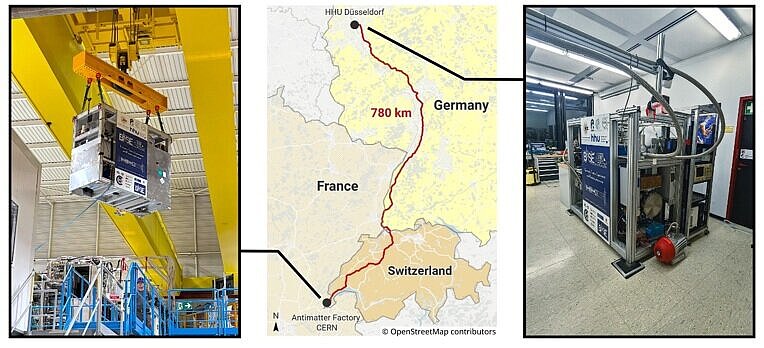
Our aim is to establish the offline operation of antiproton precision measurements outside of CERN’s Antimatter Factory, to enable the next generation of antiproton precision measurements without fluctuations and noise induced by the machines and experiments operation in the antiproton decelerator complex.
We have constructed the transportable Penning trap system BASE-STEP that is capable of transporting charged particles by crane and on a truck in an autonomous operation mode, i.e. without external power supply for up to 4 hours duration.
How does it work?

The BASE-STEP system is designed to store antiprotons and other charged particles and transport them over long distances. Since antiprotons annihilate upon contact with normal matter, they must be kept in an ultra-high vacuum environment, specifically at pressures below 10⁻¹⁶ mbar. This vacuum prevents annihilation caused by collisions with residual gas molecules over periods of several months. To achieve this, the antiprotons are stored in a cryogenic vacuum chamber, where the walls are maintained at liquid helium temperature (4.2 K). At such low temperatures, any residual gas present within the chamber freezes onto the cold walls.
The antiprotons are confined within a Penning trap, an ion trap configuration that uses a combination of electric and magnetic fields to keep them suspended at the center of the chamber. A magnetic field generated by a superconducting electromagnet forces the antiprotons into circular motion around the field lines. An electric field, maintained by voltages applied to a stack of cylindrical electrodes, pulls the antiprotons back to the trap’s center along the direction of the magnetic field lines.
Project Development and Results

The design work and construction of the BASE-STEP trap system was conducted in the Institute for Physics, at Johannes Gutenberg University of Mainz (2020-2022), commissioned at CERN (2023-2024). We have published the results from the design and commissioning phase in Review of Scientific Instruments: read here. Our paper was selected for the cover of the November 2023 issue (see here).
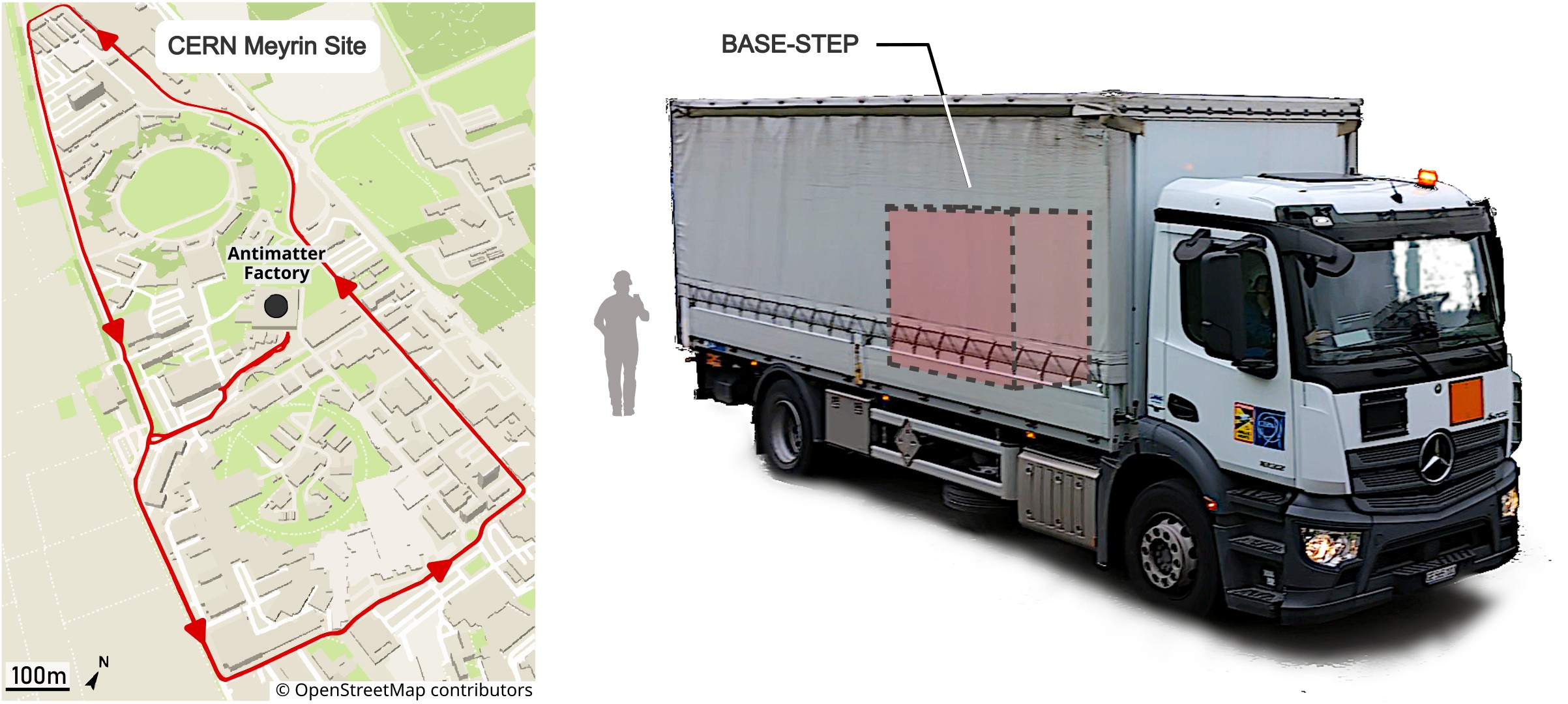
In 2024, we have trapped and transported a cloud of protons on CERN’s Meyrin site using the antiproton experiment zone of BASE-STEP as start and destination for the trip. The scientific paper reporting this work was published in Nature in 2025.
Following the successful proton transport, BASE-STEP was shut down in winter 2024/2025 and relocated to HHU, where it was operated with proton and carbon-ion measurements through spring 2025. After major hardware upgrades over the summer, BASE-STEP returned to CERN for its first antiproton beamtime, culminating in December 2025 with the successful trapping and storage of antiprotons in BASE-STEP.
First Road Transport of Antiprotons

In spring 2026, our project reached a historic milestone: the world’s first truck transport of antiprotons. For this, we trapped 92 antiprotons in BASE-STEP and, on March 24, 2026, transported them around the CERN campus for more than 20 minutes before returning to the starting point, the antiproton experimental zone of BASE-STEP, without losing a single antiproton.
This breakthrough in antimatter technology attracted significant media attention and was accompanied by a dedicated media kit from CERN. The scientific publication reporting this work is currently in preparation.
Future work
Our next milestone is to transport antiprotons to other laboratories near the Antimatter Factory. Following this, we will establish long distance transport by upgrading the transportable trap with a power generator on the truck to reach our laboratory at HHU with antiprotons.
Funding
This work was kicked-off by an ERC starting grant (ERC StG 2019, STEP, grant no. 852818) for Dr. Christian Smorra, and is now funded by the Laboratory for Quantum Technologies and Fundamental Physics of Heinrich Heine University Duesseldorf, RIKEN, the Max Planck Society, and supported by the other institutes that are part of the BASE collaboration.